

Corrugated / RFQ template
Free resource · Corrugated
Corrugated Spec & RFQ Template
The one-page checklist I wish every box RFQ started with. Fill it in, send the same sheet to every supplier you’re asking, and you’ll get quotes you can actually compare.
Fillable PDF to type into, or a printable version for a clipboard. 1 page, US Letter. No email address required: download it and use it with anyone.
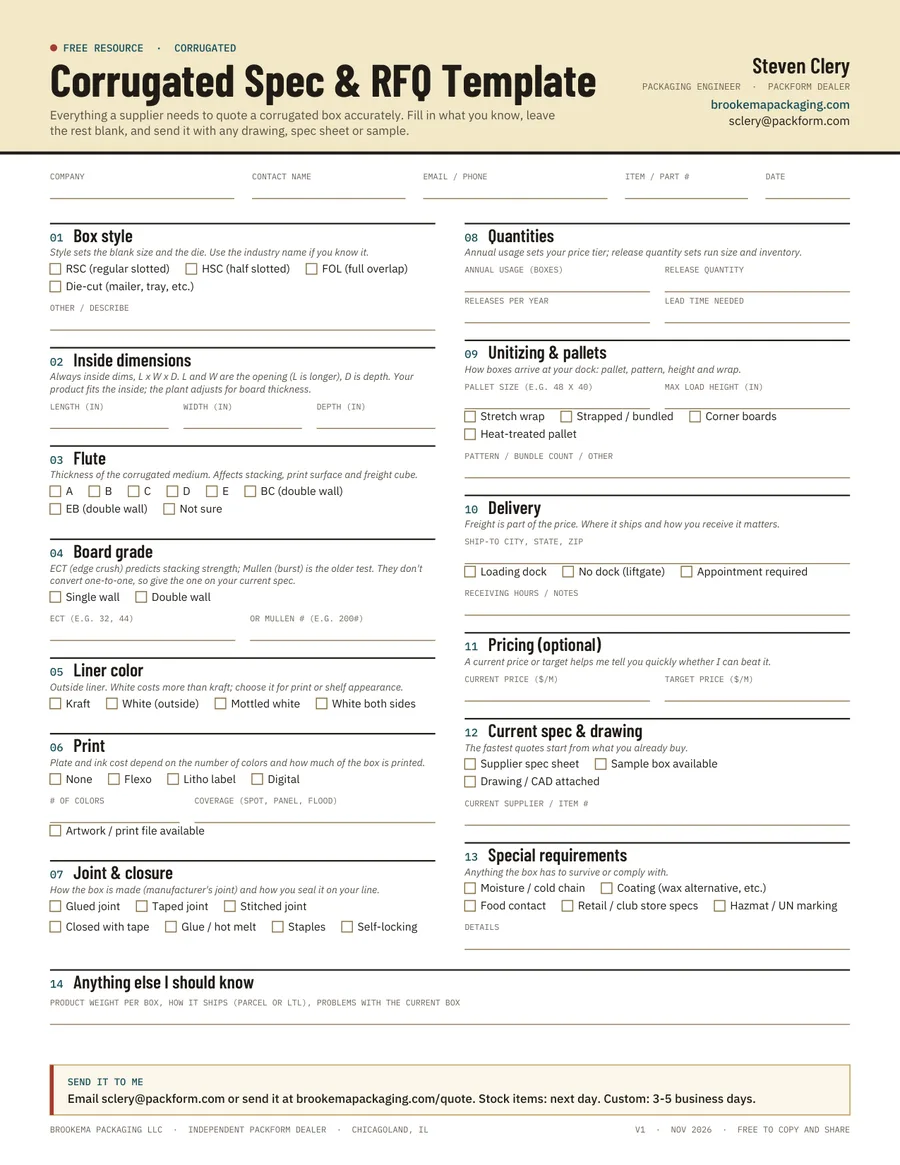
Why each line is on the sheet
Most quote back-and-forth comes from a few missing details. Here’s what each field does to the price, and why a supplier asks for it.
Box style
RSC, HSC, FOL, die-cut. Style decides the blank size and whether the job needs a cutting die, which is a one-time tooling cost. If you're not sure, describe how the flaps close and I'll name it.
Inside dimensions
Always inside, always L × W × D. Length and width are the opening (length is the longer side), depth is the third dimension. Your product has to fit the inside; the plant adds allowances for board thickness. Send outside dimensions and you can end up with boxes that are too small.
Flute
A, B, C, D or E, or a double-wall combination like BC or EB. Flute changes stacking strength, print surface and how many boxes fit on a truck. More in my flute types guide.
Board grade
ECT (edge crush) or Mullen (burst), single or double wall. ECT relates to stacking strength; Mullen relates to burst and rough handling. 32 ECT and 200# test often show up on similar jobs, but they are different tests and don’t convert one-to-one. Give the one on your current spec. See ECT vs. Mullen.
Liner color
Kraft, white or mottled white on the outside. White liner costs more, and mottled is usually a step below full white. It's worth paying for when print or shelf appearance matters.
Print
None, or how many flexo colors and how much of the box is covered. Each color generally needs its own plate, a one-time cost, and heavy coverage adds ink and press time. Send artwork if you have it.
Joint & closure
How the box is made (manufacturer's joint: glued, taped or stitched) and how you seal it on your line (tape, hot melt, staples). Closure can change flap design and score placement.
Quantities
Annual usage and release quantity are different numbers. Annual usage sets the price tier; release quantity sets run size and how much inventory sits somewhere. Both change the price per thousand.
Unitizing & pallets
Pallet size (48 × 40 is the most common in the US), pattern, maximum load height and wrap. Your dock, racking and trailer decide these, so tell the supplier up front instead of finding out at receiving.
Delivery
Ship-to ZIP, dock or no dock, appointment required. Freight is part of the delivered price, and a liftgate delivery costs more than a dock delivery.
Pricing (optional)
Your current price per thousand ($/M), or a target. You don’t have to share it, but it lets me tell you quickly whether a change is worth your time. To compare quotes on different sheet sizes, use the price per MSF calculator.
Current spec & drawing
Supplier spec sheet, a sample box or a CAD drawing. A current spec is the fastest route to an apples-to-apples quote.
Special requirements
Moisture or cold-chain exposure (corrugated loses strength when it absorbs moisture), coatings, direct food contact, retailer or club-store requirements, hazmat markings. These change the board, the coating or the whole design, so they belong on the RFQ.
What buyers ask me about box specs
- Should I give inside or outside dimensions?
- Inside. Corrugated boxes are specified by inside dimensions, length × width × depth, because that is the space your product needs. The manufacturer works out the blank and score positions from there, allowing for the board's thickness.
- ECT or Mullen: which should I put on the RFQ?
- Whichever your current box is made to. If the box carries a box maker's certificate (the round stamp, usually on a bottom flap), the grade is printed there. ECT is the more common spec today and relates directly to stacking strength. If you have neither, tell me what goes in the box, how much it weighs and how high it's stacked, and I'll recommend a grade.
- What if I don't know some of these answers?
- Leave them blank and send what you have. Dimensions, quantity and a photo of the current box are usually enough to start. A sample or a supplier spec sheet fills in the rest.
Next step
Filled it in? Send it to me.
I'll review the spec, flag anything that's driving cost, and quote it through my supplier network on Packform. Email the filled-in sheet to sclery@packform.com, or put the key details on the quote form. Stock items: next day. Custom: 3–5 business days.
Send Me the Spec